What numbers did the Coast line use for the M3 class? Were these cars
rebuilt with plywood siding? I think I found a way to kitbash them, want to
make sure I get the #s right. Thanks
William Donahue
I'll see what I can do for you...
> I am working on the listings for "preserved" ACL, SAL, SCL, SBD, & CSXT
> For ACL I have a range of at least #001 to 0786 so all SCL cabooses in
> this range are ex-ACL cabooses. How high did ACL numbers go?
>
Here is what I have for ACL cabs-(from a 1947 data book, all wooden cars)
Road numbers 01-0459 are class M3 coupola style cabs, built by ACL
Road numbers 051. 093, 0174,0187, and 0343 are class M3 wooden BW cabs,
built by the ACL1900-27
Road numbers 0461-0494 are class 0-12-A side door cabs (converted boxcars?)
built by ACL 1916-17
Road numbers 0495-0579 are clss M4 wooden coupola style cabs built by ACL
1942-43
Road numbers 0700-0731 are class M-1 (ex AB&C cabs-acq1946) built by AB&C
1908-25
Road numbers 0732-0738 are clas M-1-A 9ex AB&C cabs) built by AB&C in 1925
ACL cabs from the March 1986 issue of LINES SOUTH-
Road numbers 0600-0786 are class M5 steel coupola cabs built by ACL 1964-67
Road numbers 0787-01036 are class M5 steel coupola cabs built by SCL
1967-1970
Road numbers 01500-01501 are class M5A steel coupola cabs built by SCL in
1968
Road numbers CN&L 30-31 are class M5 steel coupola cabs built by ACL in 1967
Road numbers WSSB 667-670 are class M5 steel coupola cabs built by the ACL
in 1965.
Cars 0625, 0784, 0885, 0982, 01021, 01028 were sold to the CRR
RMC also had a feature on the M5 cars in the mid80's.
The ACL COLOR GUIDE from Morning Sun also has photos of most of these cars.
***Decals for these cabooses is MS #87-976 from 1930-1967...hosam...***
> SAL numbers appear to have mostly been in the #5200 to 5760 range by the
> merger. True?
>
>From DIESEL ERA, vol 3, #3-
SAL cabs in series 5600-5624 were built by International Car in 1949-50
SAL cabs in series 5625-5649 were built by International Car in 1951
SAL cabs in series 5650-5674 were built by SAL Portsmouth shops from
International kits in 1952
SAL cabs in series 5675-5699 were built by SAL Portsmouth shops from
International kits in 1952
***Decals for these cabooses is MS #87-151 from 1950-1960...hosam...***
The entire 5600 series cars were rebuilt by the SCL in 1970 as SCL class M6
cars in series 01050-01147. These same numbers carried over into the FLS
numbering system, and some were in service as SBD.
One car, 5622, was rebuilt into a WV style cab as an experiment, but it was
not a cost effective program, and only one car was produced, as 5622, and
renumbered to 5760 in 1965.
Model Railroader had drawings of these cars in the June 1953 issue, pg 43.
RMC had a two page feature with drawing on the SAL wooden cars in series
5211-5263 in the Nov 79 issue.
The SAL COLOR GUIDE from Morning Sun lists the cars in series 5700-5760 as
"extended vision" cabs. all were built by International in 1963, except the
5760, as mentioned above. According to the SCL FREIGHT EQUIPMENT DATA BOOK
No.1-BOX-CABOOSE, these cars carried these numbers over into SCL as class
MS-7 cars.
There were also some other WV cabs, built by the FLS/SCL-Waycross, that were
in class M8. At least 3 of these cars went to the CRR. Not sure of the
number series on these cars, but I have photographed FLS/SCL cars 01158,
01161, 01173, 01190, and 01193 on print film, and probally have more in my
slides. All of these cars wore FLS colors. I have some shots in the FLS
orange (including 01180), as well as the gray scheme. I can't read the built
date on my prints too well, so I would have to look at some slides to get a
round-a-bout set of builders dates, unless someone else can add these.
When you start talking SBD and CSXT cabs, you need to include the CRR, L&N,
and Chessie (C&O/B&O)cabs (don't think any WM cabs made it this far-may be
wrong), including the FGEX built transfer cabs(look like a caboose-2). I
beleive L&N got most of these, but the CRR got at least one, that I shot at
Collier yard in the 80's.
Russell Underwood
ACL CLASS M5 CABOOSES
Numbers 0600-0643 Built from Class O-25 Boxcars at Waycross Ga 1964-65
Had 2 separate windows at ends of cupola. Orange body, black roof.
Numbers 0644-0736 Built by the railroad in Waycross, Ga 1965-66
had 2 sliding windows in center of cupola. Orange body, black roof.
Numbers 0737-0786 Built by the railroad in Waycross, Ga 1966-67
had 2 sliding windows in center of cupola. Orange body, black roof.
#0787 was first one painted in SCL paint, Orange body, Black roof.
SCL CLASS M5 CABOOSES
The ACL cabooses retained their same numbers 0600-0736 and 0737-0808.
Paint orange body, black roof. Some of these made it to the
Family Lines with the same Orange paint.
Interior colors of cabooses
08/25/01 SMRF list
While in Atlanta I made a run by Riverdale and came back with a few goodies
including the ACL M3 cab kit. That gives me motivation to put it and the SAL
cab together at the same time. In spite of the good material in the kit on
exterior paint colors I don't remember seeing anything on the interior.
Anyone know what colors the insides of the ACL/SAL cabs were?
Larry J. Puckett
08/25/01
Odd isn't it, I posted the entire color schemes for the SAL equipment that
Warren Calloway furnished some time ago. Interior colors for cabooses
weren't included. Interior colors for camp cars were on the list
hosam
08/26/01
I think Larry is just trying to rub it in. Most of us are happy if we get
the caboose trucks the right color. Next he'll be wanting to know the color
of the seat cushions in the cupola.
RWBooneSr
08/26/01
For that it is easy. Black. The interiors of most were a very light green.
Larry Denton
08/26/01
Seafoarm green is the color. However, were not some of the interiors of the
wooden cars a suede gray or beigish color???That is what I have been told.
I was also told that the widespread use of seafoam green came along with
the steel sided cars.
Denis F. Blake
ACL RS3's
04/01/00
I am looking for some info on prototypical arrangements for bearings and
exhaust stack for SRR, ACL & SAL Alco RS2, RS-2 and RS3 road switchers as
they existed in 1953.
I have found several pictures but it most of them are taken well after 1953.
I know that the SRR replaced air cooled turbos with water cooled turbos and
rotated the stack 90 degrees when this was done.
I believe that the correct arrangement for the SRR RS-2 and RS-3 is roller
bearing trucks with lengthwise (long dimension running the length of the
engine) mounted exhaust stack indicating an air cooled turbo. SRR did not
have any RSC-2, I think?
I think that the SAL RSC-2 is friction bearing trucks with lengthwise (long
dimension running the length of the engine) mounted exhaust stack indicating
an air cooled turbo. The only RS-2 photos that I have are from the late
1960's and show the RS-2 with roller bearings and crosswise (long dimension
running the width of the engine) mounted stacks indicating water cooled
turbo. Were these features added later than 1953? I have no SAL RS-3 photos.
Unfortunately, I have nothing on the ACL.
Allen Cain
Southern RS-2 "as delivered", air cooled turbos(lengthwise stacks), roller
bearings, solid black with white trim. Same for the RS-3's. Pics of RS-2
and RS-3 in the "Diesels of the Southern Railway" by Withers. Page 83 for
RS-2, page 95 for the RS-3. Correct, Southern did not have RSC-2's. I don't
know what year the turbo's were changed.
The SAL RSC-2's "as delivered" were plain bearing(friction bearing), air
cooled turbos(lengthwise). The SAL RS-2's "as delivered" were roller
bearing, air cooled turbos. Again I don't know wht year the turbos were
changed. Photos of the as delivered are in the "Seaboard motive power" by
Withers. Page 45 for the RSC-2 and page 50 for the RS-2. The SAL RS-3's
were also delivered with air cooled turbos and roller bearings. In fact I
think all RS-3's were delivered with the air cooled turbos before 1953.
After that the water-cooled type became standard and many roads changed
theirs out. Couldn't find a pic of the RS-3's, going by delivery dates.
No problem with the ACL, they didn't have any RS-3's....
S.A. McCall(hosam)
Who said the ACL never had any RS-3s! Here is a picture of one.
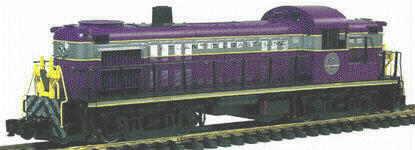
Aristocraft is very prototypical, I am sure the ACL had to have had
a whole fleet of purple Alcos... (VBG)
Pete Piszczek
Note: the above picture is from the Aristocraft web site
for a 1/29 scale model.
If they did, I missed them in my ACL diesel book. Must have been used on some
really obscure branch lines.. (VBG)
Warren Calloway
Oboy!!
Jim Roquemore
These Alco RS-3's served the duration of their terms on the ACL's Dismal
Swamp Branches in Eastern NC. Unit trains of 50-60 tankcars loaded with
Eastern NC swamp water was shipped north to aid in the production of Vicks
salve.
Marshall Stewart
Is this the Vicks plant in Greensboro? I'm sure it was the ACL that stole
the business from the old A&Y which delivered Deep River water after
processing at the special WPA-built swamp gassification plant near
Julian. Reportedly the A&Y used former CNJ camel-back's for this unit
train service, although I have not been able to locate photos of these
units or trains in action. The anthracite coal for these camel-backs was
NOT delivered from the Pennsy as you might guess, but was actually from the
local region! The Cumnock/Egypt coal mine was found to have an anthracite
layer UNDER the bituminous layer that was mined out by the 1900s! This
find was the result of the early 40's concern over U-boat attacks on oil
shipments along the coast leading to searches for energy sources using more
modern geological surveying techniques than those originally used in the
19th Century. The crews for these unit trains of swamp-gassified water for
the Vicks plant in Greensboro were given citations for the increased
production of Vicks in 1943 and 1944 which helped greatly to reduce cold
symptoms in our troops during the Battle of the Bulge.
This little known history will appear on my A&Y website April 1,
2001. Look for the updates!
Dave Bott
PS there really is a Vicks plant in Greensboro!
I don't have any records indicating it was served by the A&Y...or the ACL
for that matter :-) You can find evidence that Vicks, Cone Mills Denim,
and tobacco were three of the main Greensboro products from postcards etc
from the late steam era....
God help any newcomer who comes to this group seeking accurate information
ROFLMAO
Bob Hanson
OK, so what was the story: did ACL have or did they not have RS-3's, and, if
so, what numbers were they?
Seth Bramson
Just one, sold to them by Samples Equipment Sales of Cornfield County,
Nawth Cacalacky.
Road Number: BR-549
Thank you and goodnight.
Craig Zeni
All joking aside, NO-ACL had no ALCOs RS2/RSC2/RS3/RSC3. The first ALCO road
switchers on ACL were the Century 628s. Prior to their arrive in the early
1960s, the only ACL ALCOs were S2 switchers. No ALCOs were purchased between
the S2s and the C628s.
Warren Calloway
Just for the record: ACL didn't have RS-3 units. A&Y did not have
camelbacks either. Vicks headquarters and a plant are located in
Greensboro. The Egypt coal mine was bituminous coal and was mined during
the Civil War to fuel blockade runners. It was the whole reason the first
tracks of the Western Railroad of North Carolina (not to be confused with
the Western North Carolina Railroad which became part of the Southern's
Murphy branch) which became the Cape Fear & Yadkin Valley Railway. The
tracks ran from Fayetteville to Egypt (now called Cumnock) to get the coal
to the river. The coal seam gave out (or was too expensive to mine
profitably) in the late 19th century and was never a big revenue producer
for the Atlantic & Yadkin (which ended at Sanford after the auction and
breakup of the CF&YV in 1899). I have no evidence of traffic patterns
after 1916 unfortunately. I have reports from the NC RR Commission for the
CF&YV and I have the 1916 Shippers' Guide which lists carload lots shipped
and received at major businesses along the A&Y, but nothing later than that
except anecdotal evidence (like the highway construction for I-77 and the
bridge construction for the Chesapeake Bay Bridge leading to an increased
use of granite from the Flat Rock quarry near Mount Airy).
I'm glad people understood my original posts were in jest (hence the
reference to April 1), but it's always a good idea to provide the facts too :-)
Dave Bott
PASSENGER CAR PAINT SCHEMES
Atlantic Coast Line
According to the Walthers '42, they used Pullman green bodies and roofs,
with black trucks and white lettering on their conventional equipment.
According to a table in the Nov. 15, '47 RA, they got their first
streamlined train (Champion) in 1939.
Denis Blake that up until the '40's, the heavyweight lettering was imitation
gold in an extended Roman font. In the mid-'40's, the font was changed to
Gothic. In the '40's and '50's, the cars were Pullman green but with white
lettering.
Blake also said the first ACL E units, E3's, were painted purple and
aluminum when they were delivered in 1939. This paint scheme was later used
on ALL ACL diesel units. ACF heavyweight equipment was painted to match,
including plug door express reefers identical to REA cars which they got
around 1947, although most heavyweight Pullman equipment remained green.
In late '57, the heavyweight cars went back to Pullman green with 6 inch
deluxe gold lettering.
George Drury had an article on kitbashing a smooth-side 4-4-2 pre-WWII
sleeper in the June '75 MR, and he listed colors appropriate for these
(no mention as to eras, but I think they are original except as noted.)
For ACL, he said these were ex-NYC and were painted silver.
Blake said the lightweight cars were unpainted except for the letterboards,
number boards and what-not. These were painted purple with aluminum
lettering.
Blake said there were several versions of the lightweight scheme
There were some with purple letterboards with aluminum lettering,
and later \black lettering on unfinished letterboards. And in '48, the ACL
had a habit of painting the roofs black because they found it difficult to
keep them clean.
In 1950, Blake said, two coaches were painted to match the PRR's Southwind
and one coach repainted to match the IC's City of Miami. Later, in 1954,
another coach was painted in IC's colors.
CURVED STRIPES ON GP-7's
As I mentioned earlier, I know that the following ACL units had the
curves stripes. I have negatives of the following:
112, 135, 137, 138, 139, 144, 147, 164, 182, 186, 203, 225, 239, and 247.
A total of fourteen confirmed units. Photos exist of these.
Jim is correct in that some of the made it to SCL with the curved stripes.
I know that SCL 770 (ACL 239) was one. I have photos of SCL 770. Will go
through my SCL shots and see which of the others that I have as ACL also
made it to SCL with the curved stripes. There were some of these units that
lost their stripes before SCL, but I do not recall which units they were
with out going through my ACL/SCL negatives.
For information:
ACL 112 became SCL 700
ACL 135 became SCL 723
ACL 137 became SCL 725
ACL 138 became SCL 726
ACL 139 became SCL 727
ACL 144 became SCL 732
ACL 147 became SCL 735 *
ACL 164 became SCL 752
ACL 182 became SCL 802
ACL 186 became SCL 806
ACL 203 became SCL 823
ACL 225 became SCL 845
ACL 239 became SCL 770
ACL 247 became SCL 778
* There is a photo of ACL 147 in my ACL diesel book on page 178.
Although not related to the curved striped units, there is another piece of
trivia about the ACL GP7s that should be noted. A number of ACL GP7s
operated with the large ACL herald on the shorthood.
The curved stripes also made it to a number of ACL switchers as well. Known
to have curves stripes were: 16, 17, 34, 35, 52, 53, 55, 57, 601, 644, 652,
653, 660, 693, 701, and 711.
All of these units that did not get the short hood herald were former C&WC
units,painted into the ACL black/yellow scheme. Apparently the C&WC shop did
not have the proper stencils for the heralds. These units just had the the
two yellow striped completely aroung the short hood. There were no breaks in
the stripe for the herald. One such unit was ACl 257. Again, any one
knowing any others so painted, please let me know.
Warren Calloway
Automatic Train Control on GP7's
06/26/01
With the availability of the new P2K GP7s, several people asked what ACL GP7s
were equipped with the ATC. Checking through several ACL diagram books
resulted in the following:
100-111 no train control (had provisions for future)
112-122 gsr schedule n0. 2 intermediate inductive trail control -forward
running only
123-132 gsr schedule n0. 2 intermediate inductive trail control -forward
running only
133-152 gsr schedule n0. 2 intermediate inductive trail control -forward
running only (units 134 & 135-forward and reverse
153-172 gsr schedule n0. 2 intermediate inductive trail control -forward
running only (units 170 & 171-forward and reverse.
173-176 gsr schedule n0. 2 intermediate inductive trail control -forward
running only
177-186 no train control (or provisions for same)
187-217 no train control (or provisions for same)
218-223 no train control (or provisions for same)
224-233 no train control (or provisions for same)
234-249 gsr schedule n0. 2 intermediate inductive trail control -forward
running only
250-253 no train control (or provisions for same)
254-264 no train control (or provisions for same) ex-c&wc
265-274 no train control (or provisions for same) ex-c&wc
cn&l 100-104 no train control (or provisions for same)
Units equipped for both forward and reverse running had two pick up shoes,
One on right forward axle on front truck and one on left rear axle of rear
truck.
Also ACL 145, 155, 159, 165, 169-171, and 200 had dual control.
Initially ACL 153-176 were built with steam generators. All had steam
generators deactivated and fuel capacity changed to 1600-gallons. In a
strange move for which I have found no application, Waycross installed Train
control in ACL 109 and 110 as well as steam generators in September 1965.
Anyone know why?
Warren
HORNS ON GP-7's
03/07/01
I am interested in modeling the 113 ACL GP-7 in the 1950 - 1951 as
delivered scheme using an Atlas GP-7 as the basis. What year did ACL begin
to replace the two single blatter horns with the 3-5 chimers?
Where was the original location of the bells before moving to the roof?
Were there any other modifications done beside horns and bells to the
exterior from as delivered look?
Part of David Noble's ACL shots from North Carolina (about 67 negatives)
was donated to the State Archives in Raleigh and most show Rocky Mount
to Wilmington 1949 - 1951. The 113 was the main Wilmington switcher at
this time, based on the negatives. If anyone is interested, the phone number
is 919-733-3952 for the archives.
Larry Neal
03/07/01
Life-Like will ship their ACL GP7 within a few weeks. It will be in
the as-delivered Royal Purple and Aluminum scheme. I believe that the
ACL #117 is one of the units they will offer! You may be in luck! Now, what
7 numbers should I pick for teh lotto this evening?
Warren Calloway will be able to tell you about the horns, right?
Jim Six
03/07/01
Replacement of the single blat horns happened rather quickly. I have photos
made in 1951 and 1952 that have five chime M-5s mounted on the side ot the
short hood where the single bell horns were originally mounted. ACL later
moved them to the top of the short hood roof.
I have a Mac Connery photo of 117 with the 5-chimes on the roof top, made in
Nov. 1951, but other units have them on the sides in 1952. Most by 1955-1956
seem to have them on top of the hood. The bells seem to have moved to the
top of the short in the mid 1950s. Have aeveral photos made in 1956 that
have these roof top bell. Most earlier ones do not have the bell on top.
Warren
Fuel Tanks ON GP-7's
ACL GP7 FUEL TANK DATA
| ROAD NOS | AS BUILT | REVISED | DATE REV | S/G | B/N | B/D | NOTES |
| 100-103 | 800 GAL | 1600 GAL | 5/55 TO 2/56 | NO | 10217-10220 | May-50 | |
| 104-111 | 800 GAL | 1600 GAL | 5/55 TO 2/56 | NO | 11129-11135 | May-50 | SEE BELOW |
| 112-122 | 800 GAL | 1600 GAL | 5/55 TO 2/56 | NO | 11136-11247 | May-50 | |
| 123-132 | 800 GAL | 1600 GAL | 5/55 TO 2/56 | NO | 11914-11923 | Sep-50 | |
| 133-153 | 800 GAL | 1600 GAL | 5/55 TO 2/56 | NO | 13918-13937 | Feb-51 | |
| 154-172 | 800 GAL | 1600 GAL | 5/55 TO 2/56 | YES-800 GAL WATER | 13898-13917 | Feb-51 | |
| 173-176 | 800 GAL | 1600 GAL | 5/55 TO 2/56 | YES-800 GAL WATER | 13948-13951 | May-51 | |
| 177-186 | 1200 GAL | | | NO | 13938-13947 | Jul-51 | |
| 187-217 | 800 GAL | 1600 GAL | 5/55 TO 2/56 | NO | 13867-13897 | 05/51-06/51 | |
| 218-223 | 800 GAL | 1600 GAL | 5/55 TO 2/56 | NO | 14978-14983 | Dec-51 | |
| 224-233 | 1200 GAL | | | NO | 14968-14977 | 11/51-12/51 | |
| 234-249 | 800 GAL | 1600 GAL | 5/55 TO 2/56 | NO | 14952-14967 | 08/51-10/51 | |
| 250-253 | 800 GAL | 1600 GAL | 5/55 TO 2/56 | NO | 15945-15948 | Oct-51 | |
| 254-264 | 800 GAL | | | NO | 12897-12907 | Oct-50 | C&WC 200-210 |
| 265-273 | 800 GAL | | | NO | 14943-14951 | Dec-51 | C&WC 211-219 |
| 254 | 800 GAL | | | NO | 15599 | Dec-51 | C&WC 220 |
NOTES: ACL 109 AND 110 HAD STEAM GENERATOR/TRAIN CONTROL ADDED IN
WAYCROSS 09/65 BY CONVERTING 1600 GALLON TANK TO 800
GALLON.
OIL FIRED STEAMERS ?
Did ACL or SAL ever have any fuel powered steam or did they go directly from
coal to diesel locomotives? Thanks!
Ed Faser
Please correct me if I'm wrong but weren't--at the very least--the 4-8-4
1800's fuel oil burning? I think were several other series that were
including some of the Pacifics and some of the 0-8-0 switchers.
Interesting question, Ed.
Seth Bramson
I will have to doublecheck when I get home, but the answer I believe is not
a simple either/or. I know for a fact that I saw a couple of steam photo
shots in the Prince books that show a fuel oil (Vandy) type tender on SAL,
ACL, or a subsidiary locomotive. There was no "transition" between coal
and fuel oil though. These fuel oil steam locos would have been unusual
and local to a particular area of the systems, not part of some
well-defined plan to change the steam roster.
It is my impression that a few western railroads, the SP?, were the only
major lines to have significant numbers of oil instead of coal steam
locomotives. Oil fueled steam wasn't really an improvement as much as an
alternative to coal steam. The real "transition" in general railroading
was just from steam to diesel-electric. The reasons are many, but
generally historians point to the fact that diesels could be consisted to
better match the tonnage to the motive power, that the diesels were more
"interchangeable," and that they had relatively lower maintenance costs
(simpler parts, not maintenance downtime early on) and were "cleaner" than
steam locos. It didn't hurt in the calculations of executives that the
diesels reduced crew needs, even if historically this advantage was not
fully realized due to the social issues of putting a lot of loyal and
useful people out of work!
Dave Bott, willing to open his mouth and stick in his foot on the basis of a
little light reading at every moment!
As a high schooler, I worked in Andrews, SC as a clerk for SAL . This
was 1949-1951. At that time, most (in my recollection) of the steam that
was used at that yard used "bunker C", a fuel that I think was similar
to what we know as heating oil. In those years, the SAL was using some
Mikes on the freight line, and steam switchers.
One fine morning, I sent a tank car of asphalt to the shop thinking
it was bunker C. The hostler said it made a fine fuel, but there was
some question whether the bunker C that I had routed to the highway
contractor would satisfactorily pave a highway. Luckily, my error was
discovered before a major glitch occurred.
Jim Roquemore
Naah, Bunker C was thick, goopy stuff. UP used it in the turbines and had to
put some heat on it to get it through the piping. I think the "oil" that
railroads used was a bit higher in the refinery tower. Heating oil's
basically glorified kerosene.
David Thompson, it is around here anyway..
Were Vandy type tenders by definition oil burners? This is an interesting
tidbit for me. I do know that the ACL USRA 2-10-2's used on the Montgomery
Division had Vandy tenders. I don't know anything else about them though nor
about the use of fuel oil.
Andrew Waldo
A couple of short answers --
1. The ACL 4-8-4's were coal burners.
2. Vanderbilt tanks do not imply oil as fuel.
Bob Hanson
No Vandy tenders were not just for oil burners. They were used on the C&O
and B&O and I don't think those roads ever burned oil, except for diesels,
Larry Smith
Not at all. The Vanderbilt tender was simply a design intended to strengthen
the part of the tender that carried *water*. The fuel bunker was equally
suitable for coal or oil, as with rectangular tenders.
David Thompson
Here are some photos of SAL steam with Vandy tenders...
This is SAL #442...cant tell fuel type
This is SAL #376...loaded with coal
This is SAL #486...cant tell fuel type
This is SAL #266...cant tell fuel type
Why do the tenders have a sloping floor in the fuel bunkers? Would that be
neccessary if the loco burned oil?
William Donahue
The FEC used oil from about 1925 on (right Seth?). Many roads in the early
days of oil fuel for steamers used crude oil, later they moved to the
heavier bunker C fuel because it was cheaper. I've also heard the fuel
called #6 or #7 but I'm fuzzy on that. I remember talking to a fireman on a
tourist line in California and he told me the state required lighter oil
because of less pollutants.
I fired a steamer with oil in a museum setting. With a cold locomotive we
needed 34-40 pounds of steam just to get the oil hot enough to flow and
light the burner. We did it with burner that fit through the firebox door
and used diesel fuel. The real railroads usually used an outside steam
source. At West Palm Beach Terminal, they shut down the switch engines at
night and there usually was enough pressure (heat) left to light off the
next morning.
Robert L. Harris
Bob is correct, except that the FEC began the conversion to fuel oil
ca:1919, right after WW I.
Seth Bransom
According to Prince, at least some of the M-2 class SAL passenger
Mountains were convered to oil around 1949-50 due to coal miners'
strikes severely raising coal prices.
I believe the Prince book said some of the mikes were converted too, and
there were some locomotives converted to oil, then back to coal in the
40's. But I can't remember for sure and I don't have the book here with
me at work.
Trey Palmer
There were indeed oil burning locomotives in the South.
The Seaboard Air Line had several steam locomotives converted to oil. They
had a 0-4=0T switching tight curved industrial trackage in Columbus, Georgia
and I believe these locomotives were oil burners.
Alton lanier
There were indeed oil burning locomotives in the South.
The Seaboard Air Line had several steam locomotives converted to oil. SAL
had six 4-8-2's (242, 253, 254,257, 261, 267) converted from coal to oil.
Three Q3 class 2-8-2's (418,433, 434) were converted to oil burners. They
had a 0-4-0T (1001) switching tight curved industrial trackage in Columbus,
Georgia and this locomotive (which is on display there) burned oil. 1001 had
a different oil tank for the fuel oil it burned, the tank was built into the
saddletank over the boiler. It held 1500 gallons of water and 400 gallons of
fuel oil!
I know of no oil burners on the Southern, Central of Georgia, Atlantic Coast
Line, or L&N. The Illinois Central had a couple of oil burners, but these
were strictly short term affairs.
Alton Lanier
Y'all just look in the Prince book reprint on pages 165 to 167. Now,
what's that pile of black stuff in those Vanderbilt tenders with
those 2-10-2s?
To my knowledge, no ACL steam burned oil of any kind. If they had,
like other oil-burning railroads, the fuel most likely would have
been #2 fuel oil. By the way, #2 fuel oil is the same thing as
diesel fuel--except, nowadays, the government requires #2 fuel
(heating oil) to contain red dye so the truckers can't get away with
using it instead of the highly taxed diesel fuel (which contains no
dye).
Wayne R. Long
This is great. My new Prince SAL book earns its way.
SAL converted six of its Class M2 4-8-2 Mountains to burn fuel oil in
1945. They were Nos. 242, 253, 254, 257, 261, and 267. The tenders had been
upgraded in the 30's to hold 16,000 gals of water and after the oil
conversion could hold almost 4800 gals of fuel oil. These tenders road on
six wheel trucks.
There is a picture of one of these M2's, #261, on p.157. It was taken in
1950. The Class M2's were all scrapped by '53
Now who makes this model?
Tom Byrne
I made a mistake. the Central of Georgia also had oil burning locomotives!
The Central of Georgia had a line from Savannah out east to Tybee Beach that
was exclusively used to haul beach visitors. The line was served by 4-4-0's
and the R. E. Prince book says engines 1559, 1560, and 1561 (after 1925
renumbered to 328, 330, and 331) were converted to oil-burners about 1923 or
1924. I don't the Tybee Beach line survived much past 1930, if that long.
My dad remembers riding the train as a boy to swim in the ocean. He lived on
a farm outside Metter, Georgia and rode the mixed train to Dover and
transferred to a local passenger train to Savannah. After the abandonment of
the Tybee line, I don't think those little 4-4-0's stayed oilburners.
Alton Lanier
Last run on the Central of Georgia's Tybee District was Labor Day, 1933.
Bob Hanson
© S.A. McCall